
Whether you're just beginning your search or have been searching for years, you don't have to do it alone. When I discovered at age 52 that I had been adopted, I had no idea where to begin. Along the way, I found incredible organizations, dedicated Search Angels, genealogy experts, online communities, and fellow adoptees who generously shared their knowledge and support. This page brings together many of the resources that helped me—and others—navigate the often emotional journey of uncovering family history, understanding adoption records, using DNA testing, and reconnecting with biological relatives. I hope these links provide the information, encouragement, and hope you need as you write the next chapter of your own story.
"I just found out I'm adopted. What should I do in the next 24 hours?"
Take a deep breath.
Whether you found out through a DNA test, a conversation with a relative, a medical emergency, or by accident, it's completely understandable if you're feeling overwhelmed. Many people describe the experience as having the foundation of their identity suddenly shift beneath them.
I know that feeling because I lived it.
At 52 years old, I learned that I had been adopted. Everything I believed about my family history changed in a single conversation. Like many others, I had countless questions, very few answers, and no idea where to begin. That journey eventually led me to reunite with my birth mother in England and inspired me to write Finding Mary Smith.
If you're just beginning your own search, remember this:
You don't have to figure everything out today.
It's okay to experience conflicting emotions.
There is no "right" way to process this discovery.
You are not alone—millions of people have walked this path.
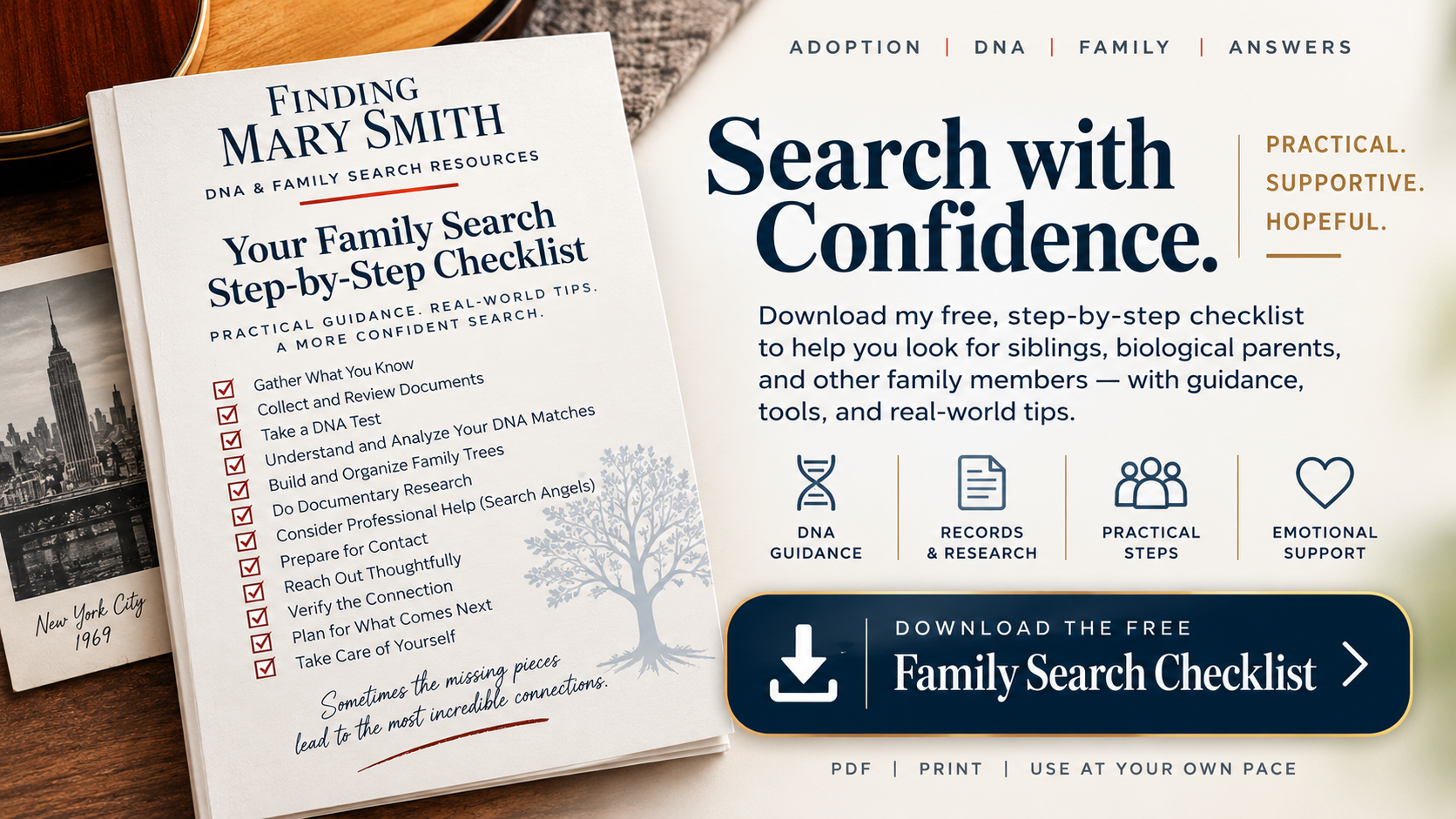
Free PDF • Print it or save it • No email required
Start Here
If you're wondering what to do next, these are the first steps I recommend:
1. Learn the language.
Understanding terms like Late Discovery Adoptee (LDA), NPE (Not Parent Expected), and Search Angels will make your journey much easier.
2. Take (or understand) a DNA test.
Consumer DNA testing has transformed family searches, but choosing the right test and knowing how to interpret your matches can make all the difference.
3. Build your family tree.
Even a small amount of information can become the key to unlocking generations of family history.
4. Reach out for support.
You don't have to do this alone. Search Angels, adoption support groups, and online communities have helped thousands of people reconnect with their families.
5. Protect your heart.
Every search is different. Some reunions happen quickly. Others take years. Some relatives are ready to connect immediately, while others need time—or may never respond. Hope for the best, but allow yourself grace no matter the outcome.
Which DNA Test Should I Take?
If you're searching for biological family, the DNA test you choose matters. Each company has different strengths, and many experienced Search Angels recommend using more than one database to maximize your chances of finding close relatives. Click on the links below to get more information.
-
Ancestry.com
⭐ My Top Recommendation for Most People
If you're just getting started, this is where I recommend beginning.
Pros
✅ Largest DNA database in the world, increasing your chances of finding relatives.
✅ Excellent family tree integration.
✅ Easy-to-understand DNA matches.
✅ Powerful tools such as Shared Matches and ThruLines®.
✅ Your raw DNA data can be downloaded and uploaded to several other genealogy sites.
Cons
❌ No chromosome browser.
❌ Some advanced tools require a paid Ancestry subscription.
Best For:
-
Best for Health + DNA
23andMe combines ancestry with optional health reports.
Pros
✅ Excellent ethnicity estimates.
✅ Detailed health reports (optional).
✅ Good chromosome browser.
✅ Strong international user base.
Cons
❌ Smaller genealogy database than Ancestry.
❌ Limited family tree features.
❌ Raw DNA cannot be uploaded into Ancestry.
Best For:
Learning about genetic health traits.
Finding close relatives who tested only with 23andMe.
-
Best for International Searches
Especially valuable if your family has European roots.
Pros
✅ Excellent European database.
✅ Strong international presence.
✅ Allows uploads from other testing companies.
✅ Powerful AutoClusters tool.
Cons
❌ Smaller North American database.
❌ Family tree tools aren't as intuitive as Ancestry.
Best For:
European ancestry.
International family searches.
-
Best Free Research Tool
GEDmatch isn't a testing company—it's a website where you upload DNA results from other services.
Pros
✅ Accepts uploads from multiple DNA companies.
✅ Brings together people from different databases.
✅ Advanced comparison tools.
✅ Free to use (with optional paid features).
Cons
❌ More technical.
❌ Smaller user base than the major testing companies.
❌ Can be overwhelming for beginners.
Best For:
Breaking through difficult family searches.
Comparing DNA across testing companies.
-
FamilyTreeDNA (FTDNA)
Best for Advanced Genealogy
One of the oldest genealogy DNA companies.
Pros
✅ Accepts DNA uploads.
✅ Excellent chromosome browser.
✅ Y-DNA testing for paternal line research.
✅ mtDNA testing for maternal line research.
Cons
❌ Smaller autosomal DNA database.
❌ Interface feels dated.
❌ Better suited to experienced genealogists.
Best For:
Deep paternal and maternal line research.
Advanced genealogy projects.
My Recommendation
If you're just beginning your search, I recommend this approach:
Step 1
Start with AncestryDNA.
It has the largest database and offers the best chance of finding close biological relatives.
Step 2
Download your raw DNA file and upload it (where permitted) to:
MyHeritage
FamilyTreeDNA
GEDmatch
This expands your reach without paying for another DNA test.
Step 3
If you're still searching—or if you're interested in health reports—consider taking a separate test with 23andMe to access a different database.
A Few Words of Advice
A DNA test can answer questions you've had your entire life—but it can also raise new ones. Before you click "View Results," remember that you may discover relatives you never knew existed, uncover unexpected family connections, or learn information that changes your understanding of your identity.
Go into the process with an open mind, and remember that every result represents real people and real lives.
A note from my own experience
When I discovered I had been adopted, I started with AncestryDNA. It became the first step in a journey that eventually reunited me with my birth mother in England. Your path may be different, but taking that first step could open doors you never imagined.
Understanding Your DNA Matches
Don't panic if your results don't make sense.
One of the biggest surprises for first-time testers is that the results often raise more questions than they answer. You may see hundreds—or even thousands—of DNA matches, but figuring out how they fit into your family can feel overwhelming.
The good news is that you don't need to understand everything on day one.
The Matches That Matter Most
🟢 Parent / Child (about 3,400 cM)
A match this close is unmistakable. If you see one, you've found an immediate family member.
🟢 Full Sibling (about 2,300–3,300 cM)
A very close relationship that's usually easy to identify.
🟢 Half Sibling, Aunt/Uncle, Niece/Nephew, Grandparent (about 1,300–2,300 cM)
These relationships often require additional detective work to determine exactly how you're related.
🟡 First Cousin (about 550–1,300 cM)
These matches can provide valuable clues, especially when multiple cousins appear on the same side of your family.
🔵 Second Cousin and Beyond
Individually, these matches may not tell you much—but together they can help build entire branches of your family tree.
What Is a Centimorgan (cM)?
A centimorgan (cM) is the unit used to measure how much DNA you share with another person.
In general:
Shared DNA Likely Relationship
3,400 cM Parent / Child
2,600 cM Full Sibling
1,750 cM Half Sibling / Grandparent / Aunt / Uncle
850 cM First Cousin
200 cM Second Cousin
50 cM More distant relative
Shared DNA can suggest possible relationships, but it usually cannot identify a relationship by itself. Many relationship ranges overlap.
Don't Focus on Just One Match
The biggest mistake many beginners make is becoming fixated on a single DNA match.
Instead, look for patterns:
Which matches are related to one another?
Do several matches share the same surname?
Are many from the same town or region?
Do they have public family trees?
The answers often emerge from the group, not from one individual.
My Advice
When I first opened my DNA results, I had no idea what I was looking at. Like many people, I expected one obvious answer. Instead, I found hundreds of names that meant nothing to me.
Over time, those names became clues. Those clues became connections. And those connections eventually led me to my birth family.
Be patient. Every family tree starts with a single branch.
Common Mistakes First-Time Searchers Make:
Contacting close matches before gathering information.
Assuming ethnicity estimates identify specific relatives.
Ignoring smaller DNA matches.
Failing to build a family tree.
Giving up too soon.
Find Your Community
You Don't Have to Navigate This Alone
One of the most important lessons I learned is that there are thousands of people who have experienced the same shock, confusion, grief, hope, and joy that often accompany an unexpected DNA discovery.
Whether you're an adoptee, a Late Discovery Adoptee (LDA), an NPE (Not Parent Expected), donor conceived, or searching for biological relatives, these organizations and online communities offer practical advice, emotional support, and experienced volunteers who truly understand the journey.
Search & DNA Assistance
🧬 DNAngels
One of the most respected nonprofit organizations helping adoptees, NPEs, donor-conceived individuals, and others identify biological relatives through DNA analysis and genealogy research. Their volunteer Search Angels have helped thousands of people reconnect with family.
Volunteer genetic genealogists who assist adoptees, NPEs, donor-conceived individuals, and descendants seeking biological family.
Facebook Communities
💙 DNA Detectives
Perhaps the largest Facebook community devoted to DNA-assisted family searches. Members share advice, celebrate reunions, and experienced volunteers often help interpret DNA results.
💙 NPE Only: After the Discovery
A private support community created specifically for individuals who discover through DNA testing that the person they believed was their biological parent is not. Members can share openly with people who truly understand the emotional impact of an NPE discovery.
💙 Late Discovery Adoptees
Several active Facebook groups support adults who learned later in life that they were adopted. These communities focus on identity, healing, reunion, and navigating relationships after discovery.
💙 DNA Surprises
A welcoming support community for anyone whose DNA results revealed unexpected parentage, unknown siblings, or other life-changing discoveries. Members often recommend it as an inclusive and supportive place for newcomers.
💙 Hiraeth: Longing for Home
A community for adoptees, NPEs, donor-conceived individuals, and family members. The focus is on healing, identity, belonging, and emotional support.
Additional Organizations
A nonprofit organization dedicated to education, mental health resources, community support, and research for people affected by unexpected parentage discoveries.
Adoptee Self-Discovery Directory
A curated directory of support groups, legal resources, coaches, books, podcasts, and organizations created specifically for adult adoptees and those navigating identity discoveries.
An excellent collection of links to organizations, Facebook groups, genealogy resources, and articles related to unexpected DNA discoveries and NPE experiences.
A Word of Encouragement
Joining one of these communities doesn't mean you have all the answers—it means you don't have to search for them alone.
Some people join because they're trying to identify a biological parent. Others are looking for emotional support after a life-changing discovery. Many simply want to connect with people who understand what they're going through.
Whatever brought you here, remember this:
You are not the first person to walk this path, and you don't have to walk it by yourself.